How Should an Oversized T-Shirt Actually Fit?
Published 13 Jul 2026 · Updated 15 Oct 2026
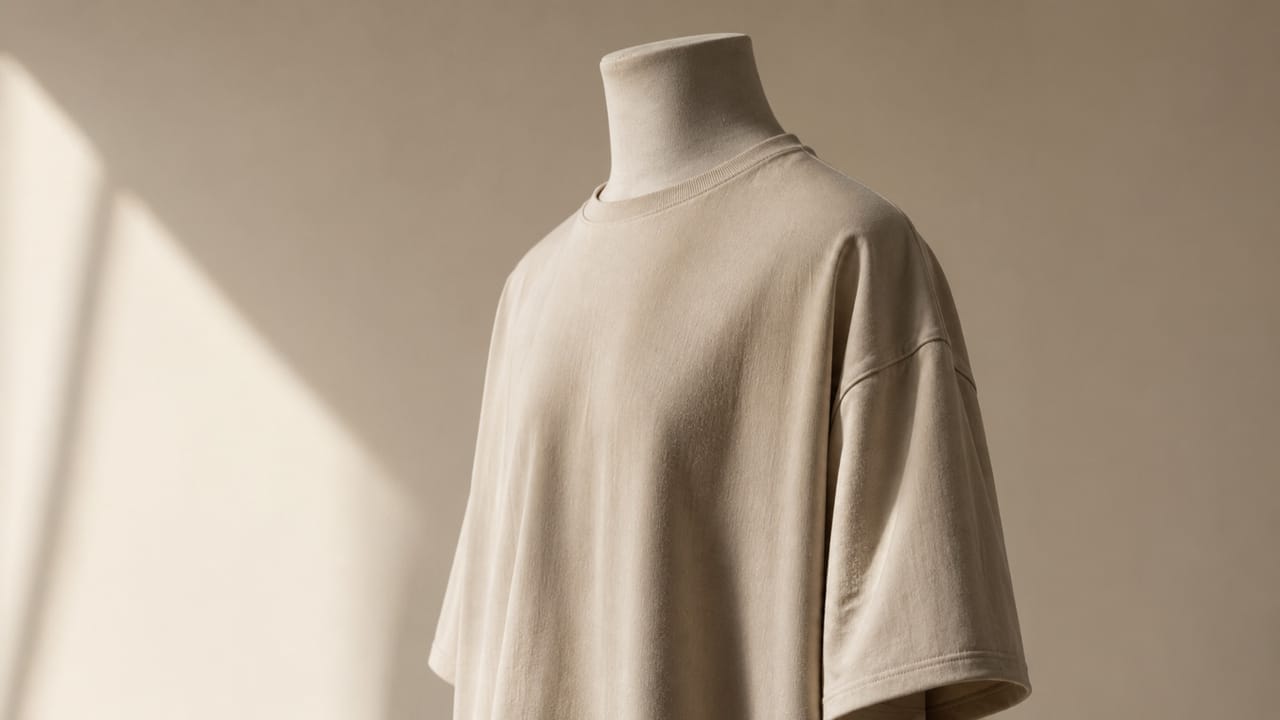
Oversized is the default cut for modern tees — but there's a fine line between "intentionally relaxed" and "wearing someone else's shirt." Get it right and it looks considered; get it wrong and it just looks big. Here's where the seams should actually land.
Quick answer: An oversized tee should look deliberate, not borrowed. The shoulder seam sits a few centimetres past your natural shoulder (a drop shoulder) — not halfway to your elbow. The hem lands between mid-fly and upper thigh. Sleeves end around mid-bicep. Because these cuts are already roomy, buy your usual size — only size up if you want it extra baggy.
To see the fit described here on real garments, every tee in our men's oversized t-shirts is cut with a drop shoulder, and each product page lists chest, shoulder and length in inches.
Key takeaways
- Oversized should look deliberate, not accidental — relaxed through the body, but still anchored at the right points.
- Shoulder seam should drop past your natural shoulder (that's the drop-shoulder look) — but not halfway to your elbow.
- Length should hit around mid-fly to upper-thigh — long enough to feel roomy, short enough to still look like a tee.
- Sleeve should end around mid-bicep — wider and a touch longer than a regular tee, never past the elbow.
- Four anchor points decide it: shoulder, chest, hem, sleeve. Miss two or more and the tee is too big, not oversized.
- When unsure, size by your usual size (our oversized fits are cut roomy by design) — or use the size guide.
Where an oversized tee should sit
| Point | Where it should sit | Too big if… |
|---|---|---|
| Shoulder seam | A few cm past your natural shoulder (drop shoulder) | It drifts toward your bicep |
| Body | Skims the chest and waist — room to move, no ballooning | Fabric tents out at the sides |
| Length (hem) | Between mid-fly and upper thigh | Past the thigh — reads as a nightshirt |
| Sleeve | Ends around mid-bicep, easy not tight | Opening flaps well past the elbow |
The shoulder
This is the giveaway detail. On an oversized tee the shoulder seam is meant to sit below your natural shoulder — that's the intentional "drop shoulder." The sweet spot is a few centimetres past the edge of your shoulder. If the seam is drifting toward your bicep, the tee is genuinely too big, not oversized.
The body and length
Through the chest and waist, an oversized tee should skim, not cling and not tent. You want room to move without excess fabric ballooning at the sides. Length is the other anchor: aim for the hem to land somewhere between your mid-fly and upper thigh. Much longer and it reads as a nightshirt; much shorter and the proportions fight the relaxed cut.
The sleeve
Oversized sleeves sit wider and a touch longer, usually ending around mid-bicep. They should look easy, not swallow your arm. If the sleeve opening is flapping well past your elbow, size down.
Two things move together here, and only one of them is length. A drop shoulder pushes the whole sleeve further down your arm, so an oversized sleeve reads longer even when it is cut to the same length as a regular one. The opening matters more than the hem: it should be wide enough to hang away from your arm, narrow enough that you cannot see daylight through it when your arms are down. A sleeve that ends past the elbow is a short-sleeve tee behaving like a half-sleeve — that is a size problem, not a style.
Oversized, or just too big?
This is the question the mirror rarely answers on its own. Check the four anchor points in order — they fail in a predictable sequence, and the first one to go is almost always the shoulder.
- Shoulder: seam 3–5 cm past your shoulder edge. Past that and the armhole starts sagging toward your ribs, which is what makes a tee look borrowed.
- Chest: you should be able to pinch a few centimetres of fabric at each side. If you can gather a fistful, it is too big; if you can pinch nothing, it is not oversized.
- Hem: mid-fly to upper thigh. Below the thigh the proportions stop reading as a t-shirt.
- Sleeve: ends at mid-bicep, opening hanging clear of the arm without flapping.
One anchor slightly out is a fit preference. Two or more out in the same direction means the size is wrong — and it is nearly always one size too many, not too few.
Oversized vs regular fit, point by point
Same garment, four measurements apart. This is what actually changes between the two cuts:
| Where it lands | Regular fit | Oversized fit |
|---|---|---|
| Shoulder seam | On your shoulder edge | 3–5 cm past it (drop shoulder) |
| Chest | Follows the body | Skims — a few cm to pinch at each side |
| Hem | At the belt or high hip | Mid-fly to upper thigh |
| Sleeve | Upper bicep, closer cut | Mid-bicep, wider opening |
| Silhouette | Tapers through the waist | Boxy — straight down from the chest |
| Fabric weight it needs | 180 GSM and up | 220 GSM and up, so it drapes instead of billowing |
That last row is the one most people skip. An oversized cut in thin fabric has nothing to hold its line — it collapses inward and reads as baggy rather than boxy. The weight is doing structural work.
That is why our 230 GSM cotton t-shirts use the same heavyweight fabric for every oversized cut: a boxy silhouette needs the weight behind it to hang square.
How to size it
Because oversized tees are already cut generously, you usually don't need to size up — buy your normal size for the intended relaxed fit, or size up one only if you want it extra roomy. Every product page has a size guide with exact measurements. And if the fit's off, we offer a true-to-size-or-free-exchange promise, so it's a low-risk call.
There are three cases where sizing up is the right call, and they are narrower than most people assume. Size up if you are near the top of your size's chest range and want the boxier silhouette; if you are tall enough that a standard hem lands above your mid-fly (height drives length more than chest does); or if you plan to layer over a hoodie. Stay at your usual size if you are between sizes — with an already-relaxed cut, the smaller of the two is the one that keeps the shoulder seam where it belongs. And size down if the shoulder seam is heading for your bicep, whatever the chest measurement says.
Fit is one thing; here's how to check overall tee quality too. Shop oversized t-shirts for men →
FAQ
How do oversized t-shirts fit?
Relaxed through the body and boxy rather than tapered, with the shoulder seam sitting deliberately below your natural shoulder. Four points define it: the shoulder seam 3–5 cm past your shoulder, a chest you can pinch a few centimetres of, a hem at mid-fly to upper thigh, and a sleeve ending mid-bicep.
Should I size up for an oversized t-shirt?
Usually no. Oversized tees are already cut roomy, so your normal size gives the intended relaxed fit. Only size up if you specifically want it extra baggy.
Where should the shoulder seam sit on an oversized tee?
A few centimetres past your natural shoulder — the deliberate "drop shoulder." If it's drifting toward your elbow, the tee is too big rather than oversized.
How long should an oversized t-shirt be?
The hem should land around mid-fly to upper thigh — roomy but still clearly a t-shirt. Much longer starts to look like a nightshirt.
Where should the sleeve end on an oversized t-shirt?
Around mid-bicep. Oversized sleeves are cut wider and sit a little lower because the drop shoulder pushes them down your arm. If the sleeve is past your elbow, the tee is a size too big.
How do I know if my t-shirt is too big rather than oversized?
Check the shoulder, chest, hem, and sleeve. One slightly out is a preference; two or more out in the same direction means the size is wrong. The shoulder fails first — once the seam heads toward your bicep, the armhole sags and the tee looks borrowed.