T-Shirt GSM Compared: 180 vs 190 vs 220 vs 230 GSM
Published 23 Aug 2026 · Updated 15 Oct 2026
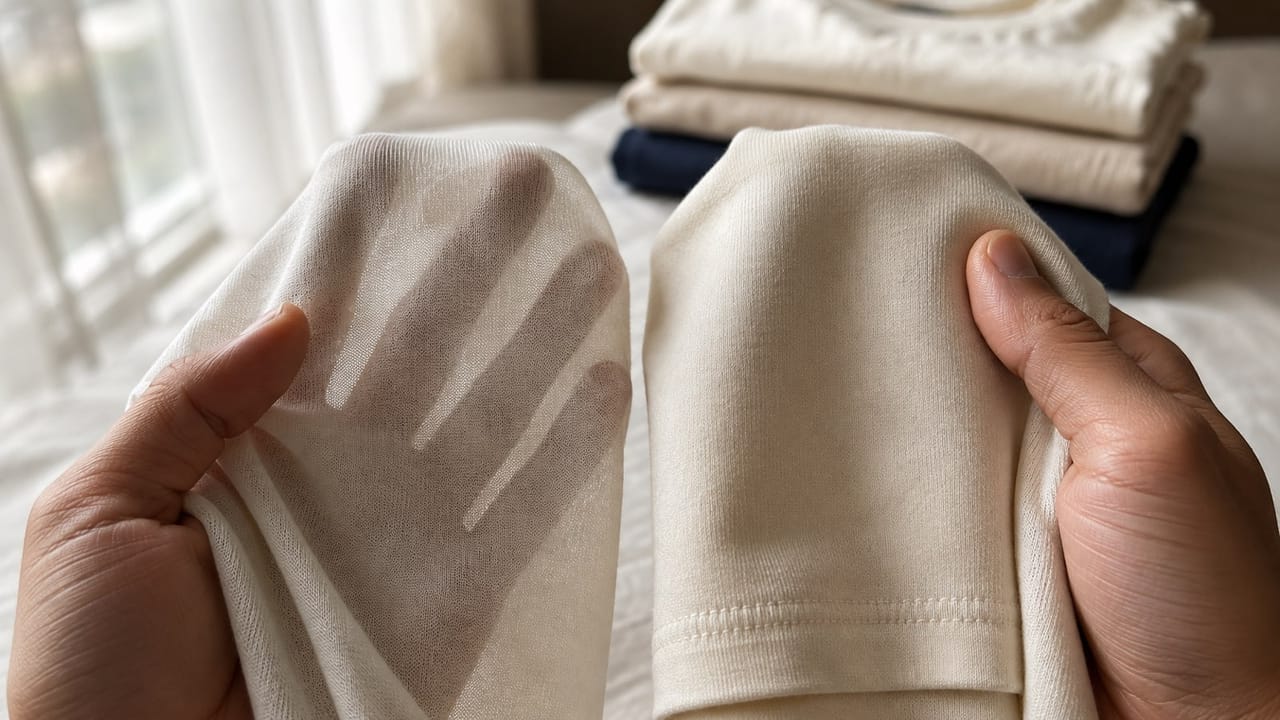
You are looking at a product page and it says 190 GSM. Or 180. Or 240. The number is presented as though it settles something, with nothing to compare it against — so it settles nothing at all.
Here is the whole scale in one table, what each band actually feels like on, and which number to want for which job. No brand can change what these numbers mean, so this works on any t-shirt, ours included.
Key takeaways
- GSM is grams per square metre — the weight of the fabric, not its quality, softness or durability.
- 140-180 GSM is fast-fashion weight: light, often semi-sheer, quick to lose shape.
- 190-200 GSM is the most common "premium" claim in India, and is genuinely mid-weight rather than heavy.
- 220-240 GSM is the durable everyday band — enough body to hold structure, still wearable in heat.
- 250 GSM and up starts behaving like a sweatshirt and gets warm fast.
- A higher number is not automatically better. GSM tells you nothing about the knit, the cotton, or the dye — the three things that decide whether a tee survives a year.
Table of contents
- The t-shirt GSM chart
- Is 180 GSM good or bad?
- 190 GSM vs 230 GSM, head to head
- The best GSM for each job
- What GSM does not tell you
- FAQ
The t-shirt GSM chart
Every band, what it means in the hand, and where it fails.
| GSM | Weight class | How it feels | Best for | Where it fails |
|---|---|---|---|---|
| 140-160 | Very light | Thin, often see-through over skin | Layering under a shirt; one-off event tees | Sheer across the chest, collar goes slack early |
| 170-180 | Light | Soft but insubstantial; drapes limply | Hot-weather basics you do not mind replacing | Loses shape within a season; prints crack sooner |
| 190-200 | Mid-weight | Noticeably more body; still fluid | Everyday regular-fit tees | Not enough weight to hold an oversized drape |
| 210-220 | Mid-heavy | Holds its own shape when you lift it | Everyday tees meant to last | Little, at this point it is a question of knit quality |
| 230-240 | Heavyweight | Opaque, structured, falls straight | Oversized fits; tees you want for years | Slower to dry; too warm if the knit is tight |
| 250-280 | Very heavy | Boxy, close to a light sweatshirt | Outerwear-style tees; cold-weather layering | Genuinely hot for most Indian weather |
One caveat before you use this as a shopping rule: these bands describe weight, and weight is only one of the things that makes a t-shirt good. More on that below.
Is 180 GSM good or bad?
Neither, on its own — but it is lighter than most people expect when a brand calls it premium.
At 180 GSM you get a tee that feels soft in the shop and thin after a month. The fabric is light enough that a dark colour can still read semi-sheer over skin, and light enough that the collar and shoulder seams carry more stress than the knit can comfortably absorb. That is why 180 GSM tees tend to fail at the neckline first.
Pale colours give it away soonest — thin fabric reads sheer against skin in cream long before it does in navy. That is the reason we hold the light shades to the same weight as everything else: the cream oversized tee is 230 GSM precisely because cream is where a lighter fabric would show.
Where 180 GSM is genuinely the right choice: a very hot climate, a loose regular fit, and a tee you are content to replace annually. Where it is oversold: anything marketed as heavyweight, structured, or built to last. It is none of those things, and a brand quoting 180 GSM as a premium spec is hoping you have no scale to compare it to.
190 GSM vs 230 GSM, head to head
This is the comparison worth making, because 190 is the most common "good" tee in the Indian market and 230 is what the durable end looks like.
| 190 GSM | 230 GSM | |
|---|---|---|
| Fabric per square metre | 190 g | 230 g — about 21% more |
| Opacity | Can read thin in light colours | Opaque in every colour |
| Oversized drape | Billows; reads as too big | Falls straight; reads as intentional |
| Shape after ~20 washes | Softens and stretches at collar | Holds structure |
| Hot-weather comfort | Slightly cooler | Comparable if the knit is open |
| Drying time | Faster | Slower — noticeably so in monsoon |
The gap that matters most is the third row. An oversized cut is a drape problem, not a size problem: without weight behind it, a relaxed silhouette has nothing to pull it into line and simply balloons. That is the single clearest case where the heavier number is not a marketing preference but a functional requirement — covered in more detail in how an oversized t-shirt should actually fit.
If you would rather feel that than read it, the olive oversized tee is the plainest example we make — 230 GSM, drop shoulder, no print to distract from how it hangs.
Where 190 wins: drying time, and a marginal edge in peak summer. If you line-dry indoors through a Mumbai monsoon, that is a real consideration and not a small one.
The best GSM for each job
Everyday tees you want to keep
220-240 GSM. Heavy enough to hold its collar and stay opaque, light enough to wear through an Indian summer. This is the band where a t-shirt stops being disposable.
Oversized and drop-shoulder fits
230 GSM and up. Non-negotiable, for the drape reason above. Below about 210 an oversized cut loses its line.
Screen printing
180-220 GSM. Printers generally prefer a mid-weight, tightly knitted surface: heavy enough not to distort under the squeegee, smooth enough to hold fine detail. Very heavy fabrics can absorb more ink than intended, and very light ones stretch as they are pulled.
Peak summer and humidity
180-200 GSM, or 230 GSM in an open single-jersey knit. Weight matters less here than weave — see below.
Children's tees
220-240 GSM, for a reason that has nothing to do with how it looks: children's clothes are washed two or three times as often as adults', so the wash count that thins a 180 GSM tee arrives in a fraction of the time. Our kids' navy cotton tee is the same 230 GSM combed cotton as the men's line, cut for someone harder on it.
What GSM does not tell you
This is where most GSM advice stops, and where it starts being misleading. The number describes mass per area. It says nothing about:
- The knit. A 240 GSM carded-cotton tee with a loose, fuzzy knit will pill faster than a well-made 200 GSM combed one. Same weight class, completely different lifespan.
- The cotton. Combed cotton has the short fibres removed, so it is smoother and sheds less. Carded does not. Both come in every GSM.
- Breathability. Decided by weave structure, not weight. An open 230 GSM single jersey moves more air than a dense 190 GSM interlock.
- The dye. Colour-fastness is a chemistry question — see why black tees fade. A heavy tee that greys in a month is still a tee that greys in a month.
- Whether it was pre-shrunk. Un-pre-shrunk cotton loses a size on the first hot wash at any weight.
Which is why GSM is a filter and not a verdict. Use it to rule out the obviously-too-light, then judge the rest on knit, cotton and finishing — the checks in how to check t-shirt quality before you buy.
Where we landed, and why
We build at 230 GSM combed cotton in an open single-jersey knit — the top of the everyday band rather than the bottom of the sweatshirt one. Heavy enough to hold an oversized drape and stay opaque; open enough in the weave that it still breathes through a Bengaluru April.
The weight is the part you can feel. The parts you cannot are pre-shrunk cotton, colour locked to Delta-E under 1.5, and a heat-transfer inner label instead of a stitched tag. If you want the longer version of that reasoning, it is in our plain-English guide to what GSM should be.
- Oversized Heavyweight Cotton T-Shirt — Olive Green — the plainest way to feel the difference 230 GSM makes to a drop shoulder.
- Men's Solid Cream Oversized Cotton T-Shirt — cream is where thin fabric gives itself away; this one stays opaque.
- Kids' Cotton T-Shirt — Navy — same 230 GSM, cut for children who are hard on clothes.
FAQ
What does 190 GSM mean on a t-shirt?
It means one square metre of the fabric weighs 190 grams. In practice that is a mid-weight tee — more substantial than fast fashion at 160 GSM, lighter than a heavyweight at 230. It is the most common weight sold as premium in India.
What does 200 GSM mean?
200 grams per square metre — the upper end of mid-weight. A 200 GSM tee holds its shape reasonably well in a regular fit but is still light for an oversized cut.
Is 220 GSM good for a t-shirt?
Yes. 220 GSM sits inside the durable everyday band, with enough body to keep its collar and stay opaque. Whether a particular 220 GSM tee is good then depends on the knit and the cotton, not the weight.
What does 240 GSM mean, and is it too heavy?
240 grams per square metre — solidly heavyweight. It is not too heavy for year-round wear in most of India provided the knit is open, but it dries slowly and can feel warm in a dense weave.
What does 250 GSM mean on a t-shirt?
250 grams per square metre, which is where a t-shirt starts behaving like a light sweatshirt: boxy, very structured, and warm. Good for layering, less good for an Indian summer.
What is the average t-shirt GSM?
Most mass-market t-shirts land between 150 and 180 GSM. The average for tees sold as premium is closer to 190-200. Anything at 230 and above is a deliberate choice by the maker, because the fabric costs more.
Is 180 GSM vs 220 GSM a big difference?
Yes — about 22% more fabric. You notice it immediately in opacity and in how the tee hangs, and again after twenty washes in how well the collar has held.
What is the best GSM for t-shirt printing?
Typically 180-220 GSM. Printers want a stable, smooth, tightly knitted surface: heavy enough not to distort under the squeegee, not so heavy that it drinks ink.
Does higher GSM mean better quality?
No. It means heavier. Quality comes from the knit, the cotton staple, the dye and the finishing — a well-made 200 GSM combed-cotton tee will outlast a poorly made 240 GSM carded one.
VastraCore makes 230 GSM combed-cotton tees for men and kids — pre-shrunk, colour locked to Delta-E under 1.5, no itchy tags. See the 230 GSM range →